
Form OTN-1 · Register
Loading the Register.
Form OTN-2
Get the
new issue.
Monthly intel on jurisdictions, structures, and entity strategy for builders in crypto and tech.
Form OTN-1 · Register
Loading the Register.
Form OTN-2
Monthly intel on jurisdictions, structures, and entity strategy for builders in crypto and tech.
This is to certify that the entry
was filed in the Register on 18 February 2021, under the jurisdictions Articles and Capital Formation.
Standfirst
Launch pools have the potential to turn capital formation on its head by letting the community stake in a refundable pool which turns into committed capital once a project passes a vote. Here's how.
Capital formation is the Holy Grail of decentralized finance: how to preserve the ease of DeFi-style staking with the process of raising capital for a project, a company or a fund?
On the one hand, DeFi-style pooling is fast, cheap (even with high gas fees…) and global: users simply send their crypto to a pool and get a share of the pool. A pool for an Automated Market Maker or a lending protocol can collect tens of millions of dollars in a week.
On the other hand, capital formation for companies uses a more complex investment contract for shares, notes or units. The offer includes a lot of details that take time to figure out and money to document. It is subject to securities regulations about how it can be sold, and who it can be sold to.
Launch pools are what you get when you cross DeFi-style pooling with escrow on blockchain to simplify capital formation.
It essentially reshuffles the sequence of how you raise money for your project, by first engaging investors with a refundable escrow pool and only turning it into committed capital once the project passes a community vote.
You have time to do what’s necessary to make the deal work, depending on the needs of your project: you choose a legal form, accredit investors, or in some circumstances you can swap the pool tokens into a utility token and go fully decentralized.
In designing the launch pool, we took inspiration from the SPAC (Special Purpose Acquisition Company) which has recently received a lot of attention in the legacy financial world.
SPACs ask investors to invest in an IPO of an acquisition target before the target is known.
Why would you ever do that? The answer is that SPACs limit risk at each stage:
For our design of a launch pool, we took some of the above features of a SPAC, but we used DeFi to keep assets (and their returns) in the hands of the investor, whilst pushing out the legal setup.
The lifecycle would look as follows:
Variations to the above could include a set-and-forget option that automatically commits stakers who do not want to follow the whole discussion.
Intended benefits include:
Launch pools do not have to be limited to startups and new ideas.
We see a very powerful application for organizing investment funds. Funds can “Launch” and “Organize” in collaboration with investors.
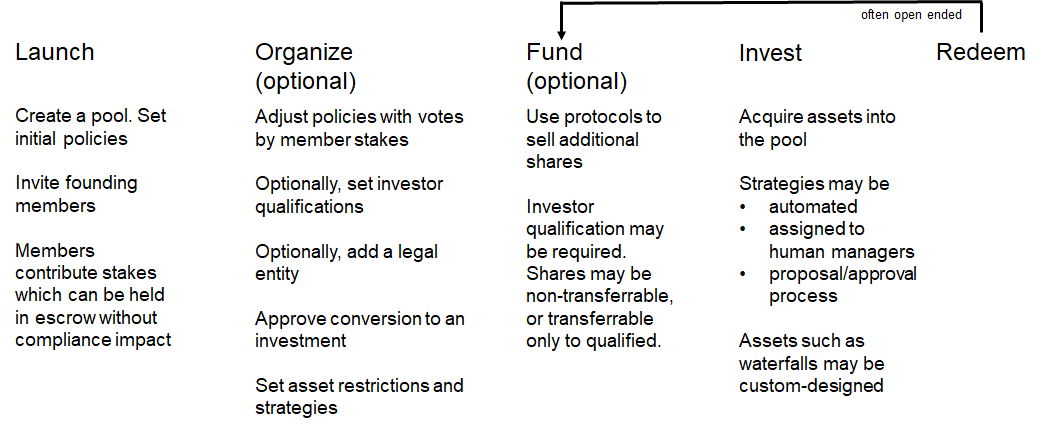
The setup described above has the potential to move investment activity away from expensive fund management to onchain scripts.
To setup a launch pool to raise capital for a fund, you would need:
Other use cases too come to mind:
So far our design is still on the drawing board with an initial spec for the launch pool smart contract, but we have yet to build a product around it.
Some of the decisions we’ll need to make towards a first launch pool are:
Eventually, launch pools could be offered on otoco.io as the first component along an onchain investment deal “assembly line”.
Such assembly line will in most cases require a legal wrapper in the form of an onchain LLC or some other legal entity, components OtoCo and otonomos.com already offer.
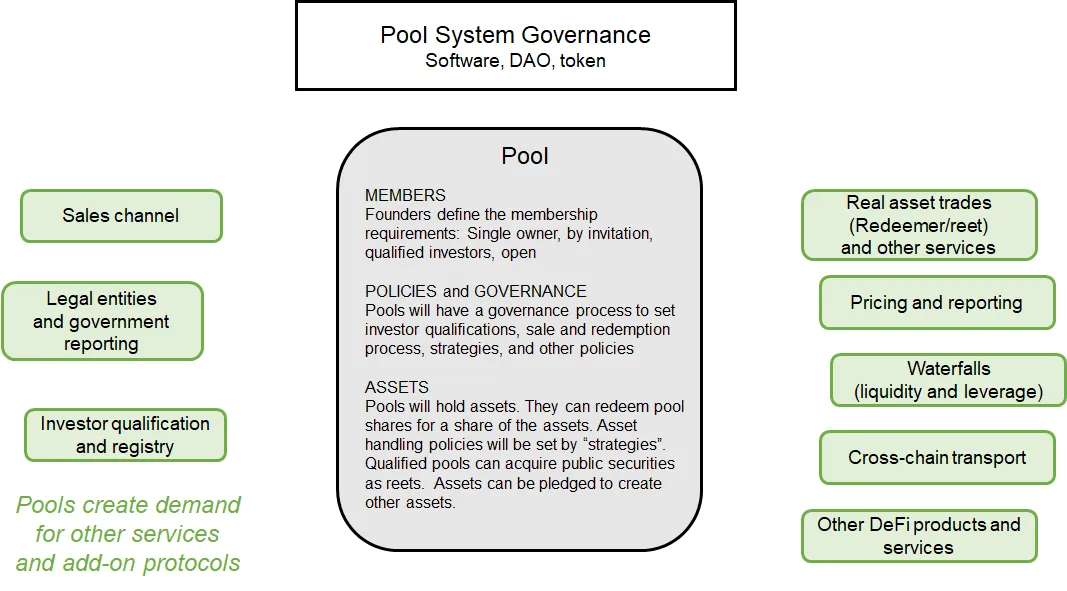
Other components users may need are services that qualify investors and track investor qualifications associated with blockchain addresses. Some pools will need to use this information to create real-name registries of their investors.
Below is an overview of the add-on services and protocols for pools:
Elon Musk once said that the secret of building successful companies is to make sure people really REALLY want your product to exist.
With launch pools, if the community really really wants some project to happen, we should give them the tools to stake projects, reward early stakers, and get into a committed deal as frictionless as possible.
OtoCo will soon be running its own launch pool to test if the community really really wants OtoCo to happen the way we have it planned: as an onchain assembler of pools and organizations for the crypto and blockchain economy. Think WordPress for decentralized projects, only better, smart contractified and with a dApp plugin store.
To help us design our launch pool, we’ve put together a short poll which also lets you pre-register.
Reference
Pre-register now — g975o75bm6x.typeform.com
If you’r reading this on mobile, you can also just scan the QR code below to pre-register:

Based on the poll’s results, we’ll craft a specific proposal for OtoCo and broadcast it to the community together with our launch pool smart contract address.
As a contributor, you will be able to put refundable stakes into the pool and vote on our investment thesis. The earlier you stake, the bigger your reward if you eventually commit.
Join our official Telegram group to receive updates.
| Entry no. | Filed | Jurisdiction | Exhibit | Name of record | Pages | Status |
|---|---|---|---|---|---|---|
| OTN-2025-013 |  | Company formation and corporate services: the last analog bastion of the business world In this post, we examine the quirks of the US$100BN a year corporate services market and how the interplay between blockchains and AI have the potential to drag it into the… | 01 | Filed | ||
| OTN-2024-024 | No cover on file | When to switch from a prop trading rig to a full fund Are you a crypto proprietary trader thinking of taking things to the next level by setting up a fund? Here is what you need to know. For a lot of us, the big appeal of proprietary… |
Form OTN-2
Monthly intel on jurisdictions, structures, and entity strategy for builders in crypto and tech.
End of entry OTN-2021-004
Filed by Otonomos
| 01 |
| Filed |
| OTN-2024-023 |  | What to ask yourself when you set up a DAO DAOs are major elements of the Web3 world. As funding tools and mechanisms for decentralised collaboration and consensus, they highlight the some of the most exciting… | 01 | Filed |